The hashing nodes compute content hashes of a media file. They are the foundation of asset identity in MetaLoom: the SHA-512 hash is the content key used to look an asset up, avoid recomputation, and match against blacklists. Four kinds live in the same module and can be toggled independently.
Kinds |
|
Applies to |
Any file |
Input ports |
|
Output ports |
|
Requirements |
CPU only. Streams the file, so memory use is low regardless of file size. Reads the full file bytes from storage. |
Persists to |
|
chunk-hash computes a content-based chunked hash used for near-duplicate detection on partially
modified files.
Configuration
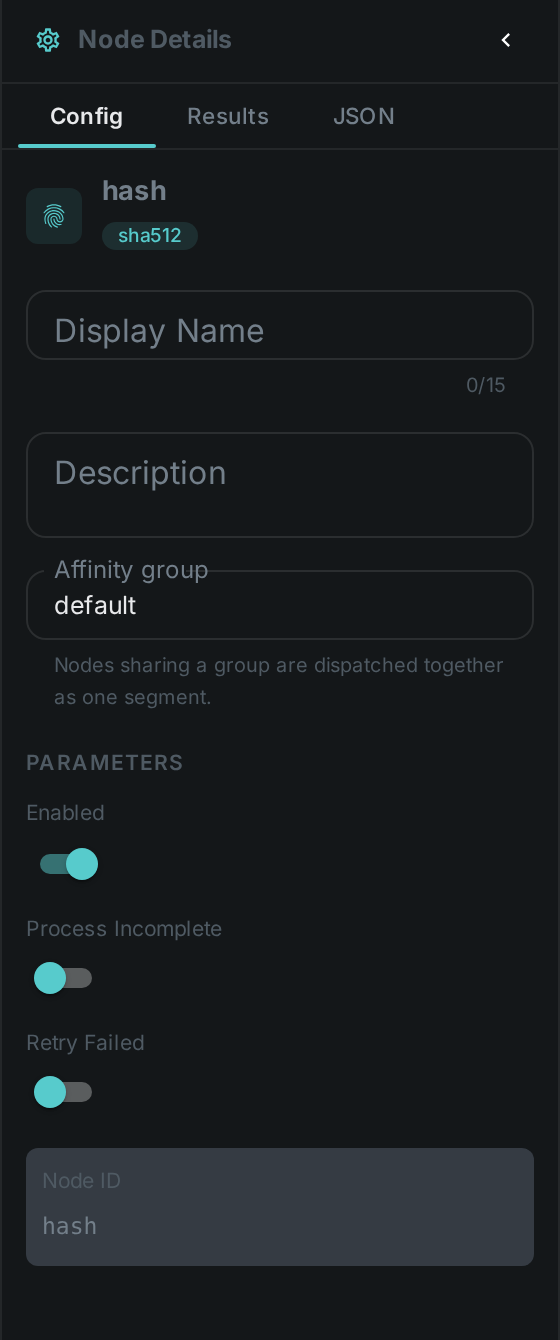
Per-node options enable each algorithm individually. Set them in the panel above, or in
the node’s options block in a pipeline definition:
| Option | Default | Meaning |
|---|---|---|
|
off |
Compute the MD5 hash |
|
off |
Compute the SHA-256 hash |
|
on |
Compute the SHA-512 hash (the system-wide content identity) |
|
off |
Compute the chunked content hash |
In online mode a hash node checks Loom first and short-circuits when the hash is already stored.
Seeing it run
Turn on Debug Mode and every node keeps what it produced, on the
card itself. Below is a real run of this node over pexels-photo-2379005.jpeg.
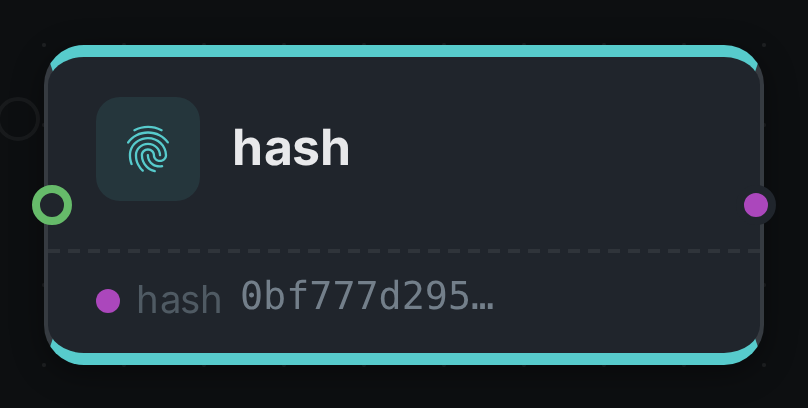
The strip on the card lists what each output port carried — hash.
Use Cases
-
Asset identity — resolve an asset by its SHA-512 across the platform.
-
Exact deduplication — find byte-identical files (see Deduplication).
-
Near-duplicate detection —
chunk-hashflags files that were partially modified. -
Blacklisting — match incoming media against a hash blacklist.